US Study Identifies Battery Energy Density Target For Persistent Solar Flight
Achieving 500 watt-hours per kilogram could enable pilotless solar aircraft to remain airborne in the stratosphere for months at a time.
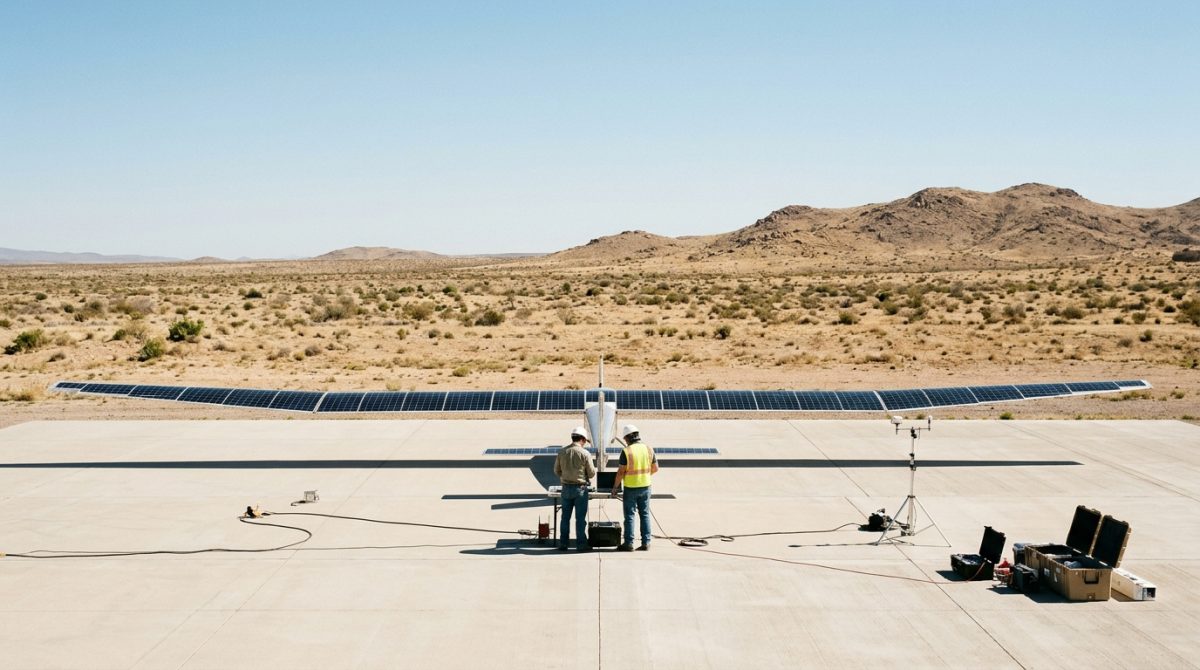
A new study led by researchers in the United States has established a performance target for battery energy density that could allow solar-powered aircraft to sustain flight for weeks or months. By reaching a threshold of 500 watt-hours per kilogram (Wh/kg), pilotless planes operating at 60,000 feet could effectively monitor wildfires, hurricanes, and climate patterns while remaining airborne overnight.
The research, published in ACS Energy Letters, highlights the engineering challenge of balancing energy storage with aircraft weight. Craig Mascarenhas, who led the study through the laboratory of Harvard atmospheric scientist Jim Anderson, noted that heavier batteries require more power to generate the necessary lift, creating a difficult circular relationship. The team concluded that for these missions, energy density is significantly more important than power density, as the aircraft require consistent energy storage rather than rapid power delivery.
The proposed 500 Wh/kg target is approximately double the energy density of current commercial electric-vehicle batteries, which typically reach about 250 Wh/kg. While experimental cells have already achieved roughly 400 Wh/kg, Mascarenhas noted that cost remains a primary barrier to widespread adoption, though prices are decreasing. The study serves as a development roadmap rather than a demonstration of a new flight mission.
The project aims to improve upon existing observation methods, such as those used by NASA’s ER-2 research aircraft, which are limited to missions of six to eight hours. By utilizing solar-powered, pilotless aircraft, researchers hope to provide longer observation windows and reduce operational costs. The research team included contributors from Harvard’s John A. Paulson School of Engineering and Applied Sciences, the University of Michigan, and industry partners, including aerospace entrepreneur John Langford.